There are times during the year that the ensign is
flown at half-mast, or half-staff ashore. This is the
internationally recognized symbol of mourning.
Normally, the flag is half-masted on receiving
information of the death of one of the officials or
officers listed in U.S. Navy Regulations. Notification
may be through the news media or by official message.
The United States honors its war dead on Memorial Day
by flying the flag at half-mast from 0800 until the last
gun of a 21-minute gun salute that begins at noon (or
until 1220 if no gun salute is rendered).
If the ensign is flown from the flagstaff and is
half-masted, the union jack is also half-masted. In
half-masting the national ensign, it will, if not already
hoisted, first be hoisted to the peak and then lowered to
the half-mast position. Before lowering from the
half-mast position, the ensign is hoisted to the peak,
then lowered ceremoniously. Distinctive marks, such as
commission or command pennants, are not half-masted
except when the ship’s commanding officer or the unit
commander dies.
U.S. Navy Regulations stipulates that when any ship
under United States registry or the registry of a nation
formally recognized by the United States salutes a U.S.
Navy ship by dipping its flag (hauled halfway down and
then raised), the courtesy is to be returned dip for dip. A
U.S. Navy ship never dips to a foreign ship (flag) first.
U.S. naval ships (USNS) of the Military Sealift
Command do not dip the national ensign to Navy ships
since they are public ships of the United States.
Formal recognition of a foreign country does not
mean that diplomatic relations must exist. The fact that
diplomatic relations have been severed does not mean
that the United States no longer recognizes the existence
of the state or the government concerned. However, the
United States does not return the dip to countries such as
Albania, North Korea, Vietnam, and South Yemen. If in
doubt, ask the duty Signalman.
UNION JACK
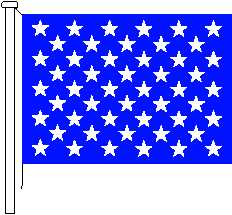
The union jack is the rectangular blue part of the
United States flag containing the stars. It is shown in
figure 4-18. It symbolizes the union of the states of the
United States. Each star represents a state.
When a naval ship is in port or at anchor, the union
jack is flown from the jackstaff from 0800 to sunset. In
addition to flying from the jackstaff, the union jack is
hoisted at the yardarm to indicate that a general
court-martial or a court of inquiry is in session.
The union jack is flown in boats as follows:
1. When a diplomatic official of the United States,
at or above the rank of charge d’affaires, is
embarked in a boat of the U.S. Navy and is
within the waters of the country which that
person represents
2. When a governor general, or a governor
commissioned as such by the President, is
embarked in a boat in an official capacity and the
boat is within the governor’s area of jurisdiction
(for example, the Governor of the Virgin
Islands)
When displayed from the jackstaff, the union jack is
half-masted if the national ensign is half-masted. It is
raised and lowered in the same manner as the national
ensign. The union jack is not dipped when the national
ensign is dipped.
The union jack is issued in several sizes; but, when
flown at the jack staff, it must be the same size as the
union of the ensign flown at the flagstaff. To make sure
it is not flown upside down, always have the single point
of the stars pointing toward the sky.
4-22
UNION JACK
BMRF0418
Figure 4-18.—Union jack.
Student Notes: