The men filling these chief billets were actually
first and second class petty officers. The classifica-
tion of these ratings can be seen in figure 7-5.
A significant change to uniforms and rating
badges occurred in 1886. The first class petty
officer wore a double-breasted, sack-style jacket,
while petty officers second class and below
retained the traditional jumper-style uniform. The
first class rating badge consisted of an eagle, three
chevrons, and a specialty mark. The master-at-
arms rating badge, however, consisted of an eagle,
three chevrons, a specialty mark, and three arcs
or rockers. This jacket along with the master-at-
arms rating badge falsely led many people to
believe this was a chief petty officer uniform.
On 25 February 1893, President Benjamin
Harrison issued an executive order outlining the
pay scale for Navy enlisted personnel. This
executive order was issued to the Navy as General
Order Number 409 (fig. 7-6). This general order
divided the pay scale into rates and for the first
time listed CPOS. Both General Order Number
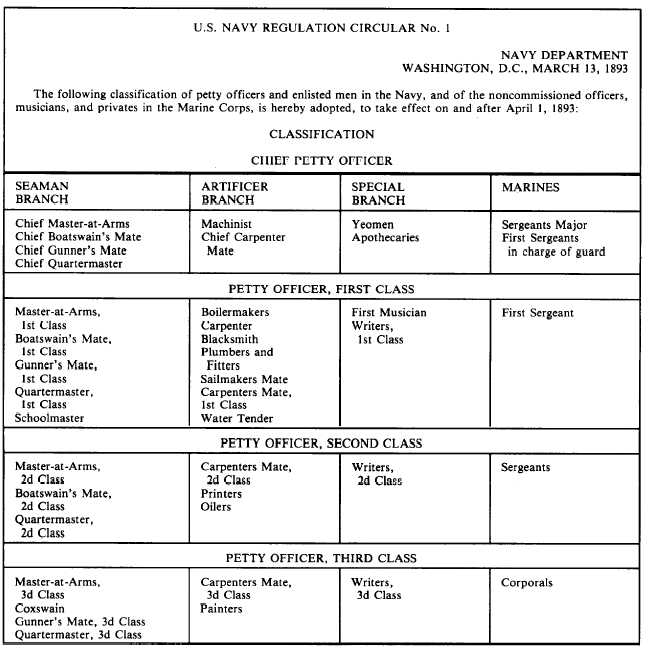
409 and U.S. Navy Regulation Circular Number
1 (fig. 7-7) listed chief petty officers as distinct
Figure 7-7.-U.S. Navy Regulation Circular No. 1.
7-13